No servers, ever
The app has no account and no backend, and never connects to the internet. There is nowhere for your data to be sent, so the developer and any third party simply never get it.

Between two STI tests, all you have is a feeling. SixtyNineMSM models what you actually did — encounter by encounter — into the probability of having acquired an infection since your last test, calibrated against UK surveillance data and computed entirely on your iPhone.
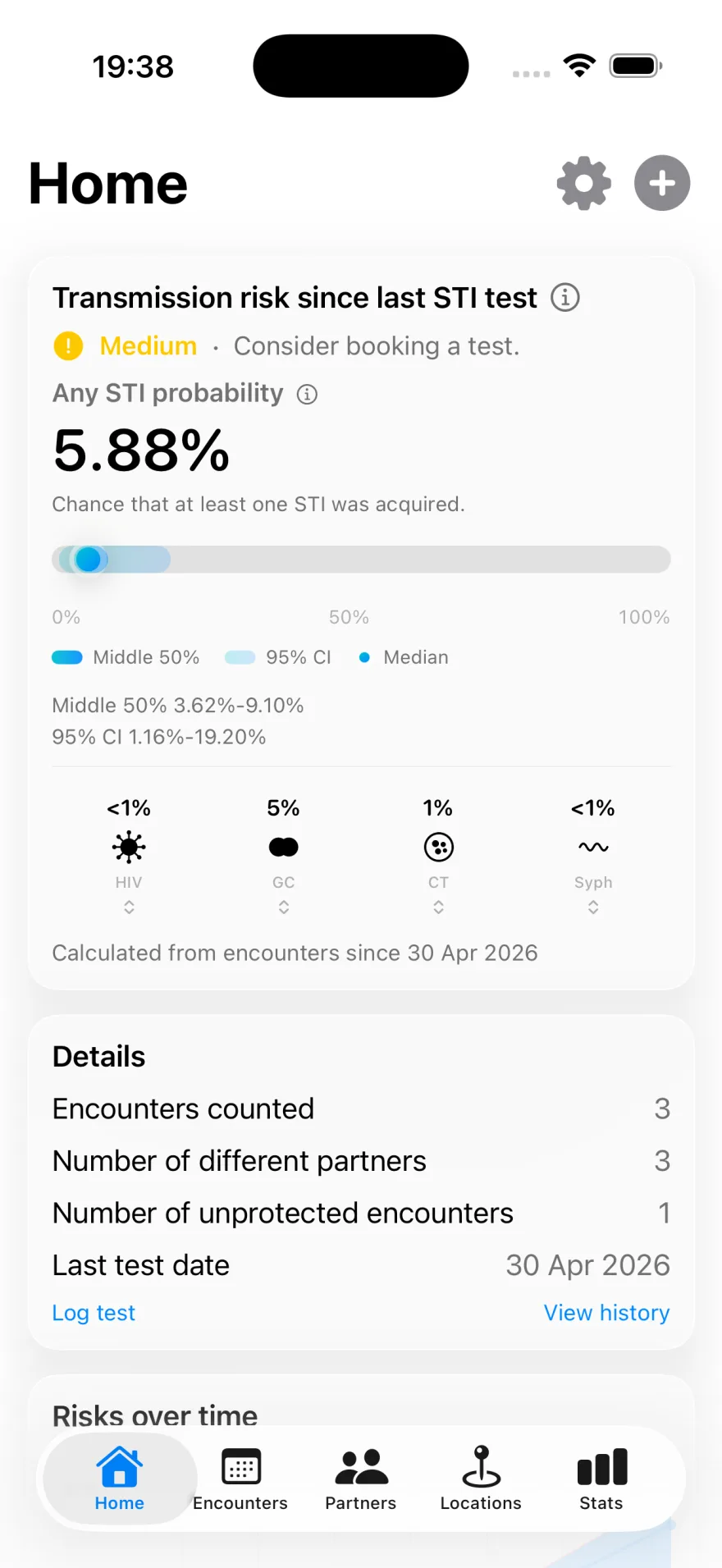
A test measures a single point in time; risk accumulates continuously between them, and individual encounters combine in ways that resist intuition. SixtyNineMSM reports one overall probability, a separate estimate for each of the four, and the uncertainty in every figure — never false precision.
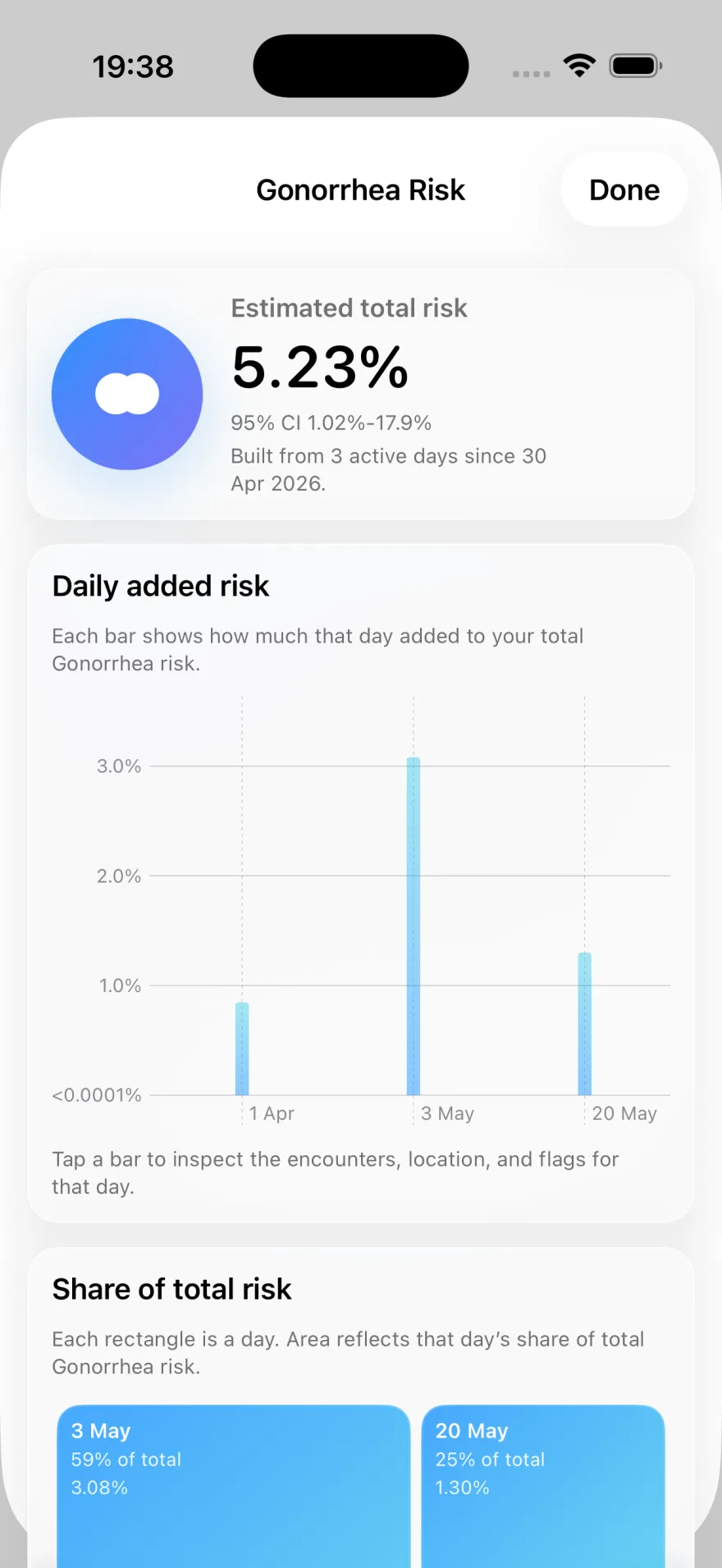
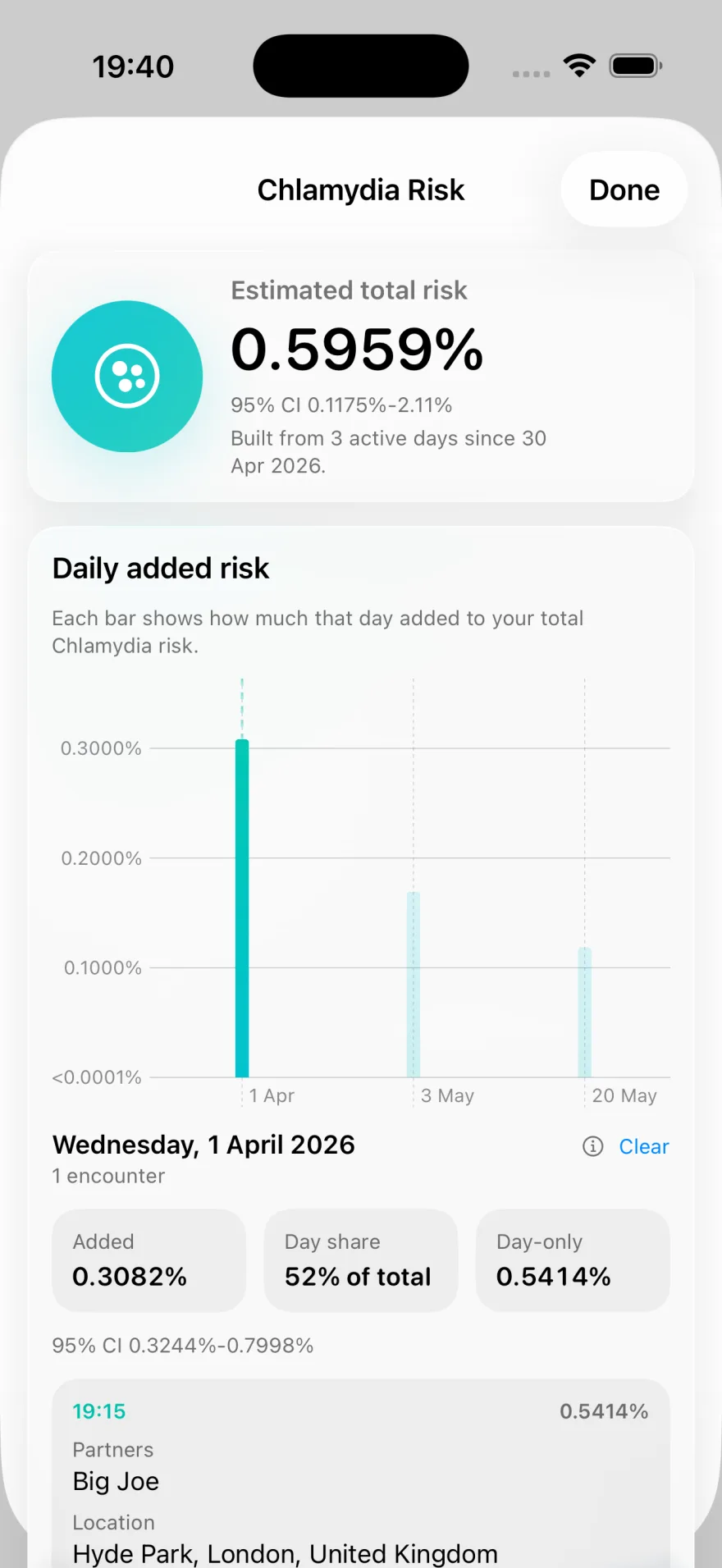
A single percentage is more useful when its components are visible. The estimate is decomposed by day, by encounter, and by STI — separating the events that materially changed your risk from those that didn't. A negative test result re-anchors the baseline, and the model starts accumulating from there.
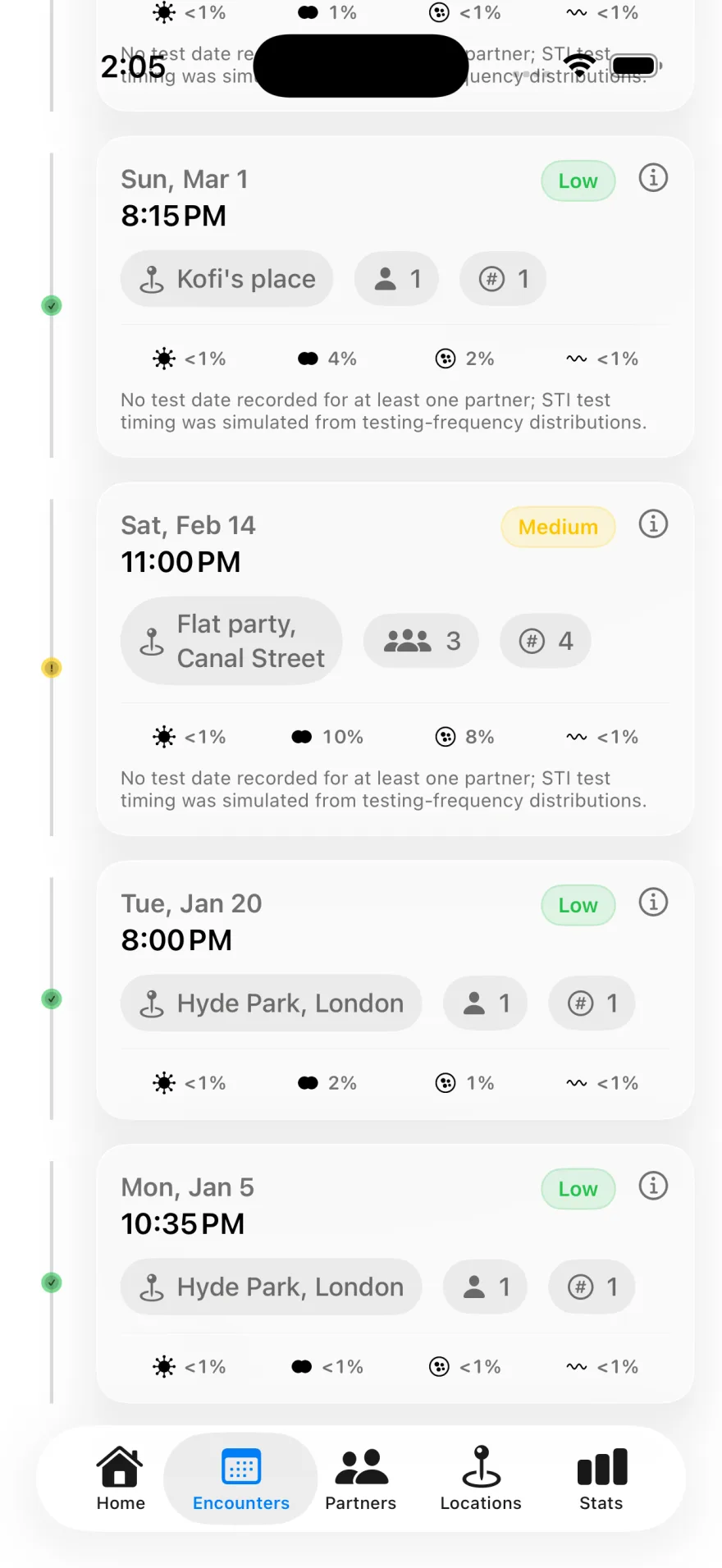
Condoms, PrEP, vaccination, and partner viral suppression each adjust the per-act transmission probability. SixtyNineMSM applies them to every encounter you record, so the effect of each intervention is measurable.
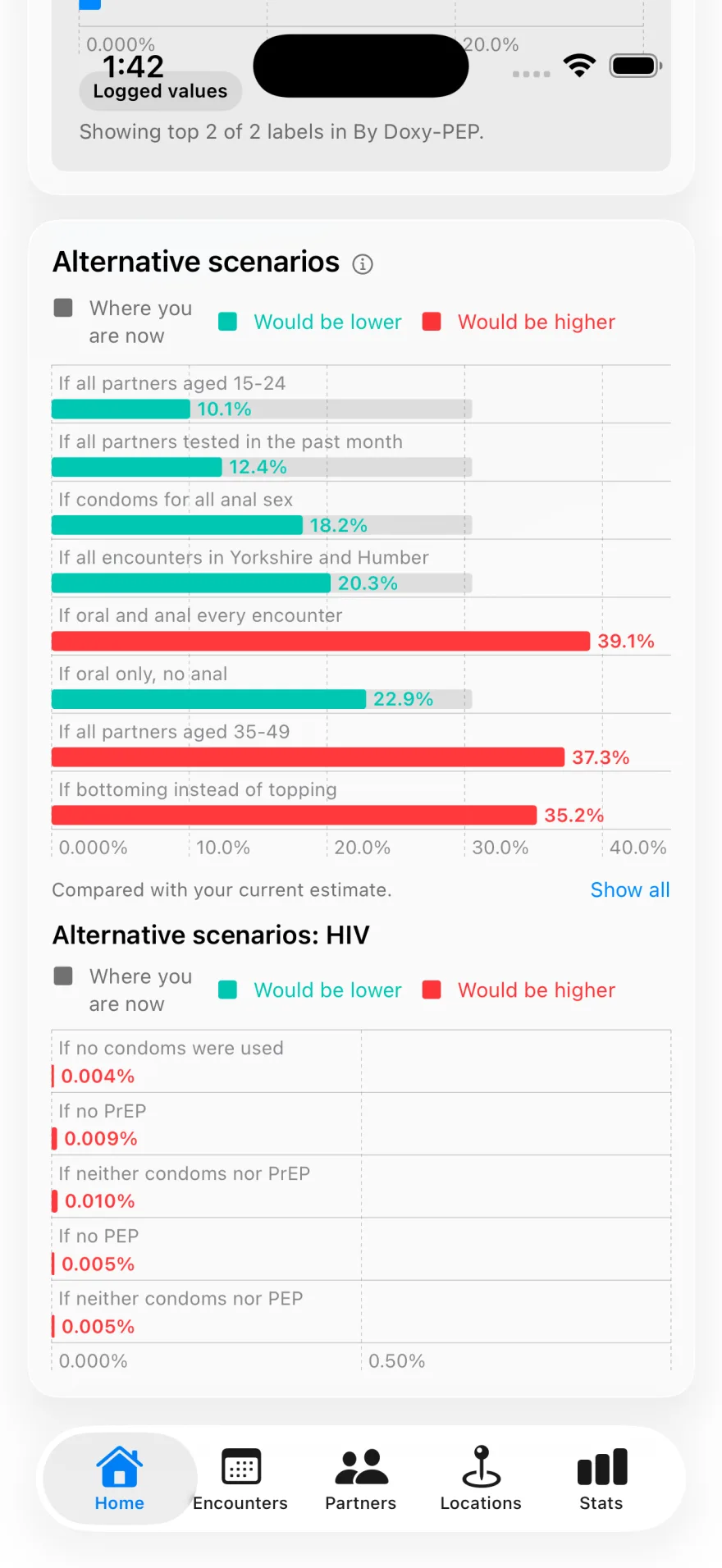
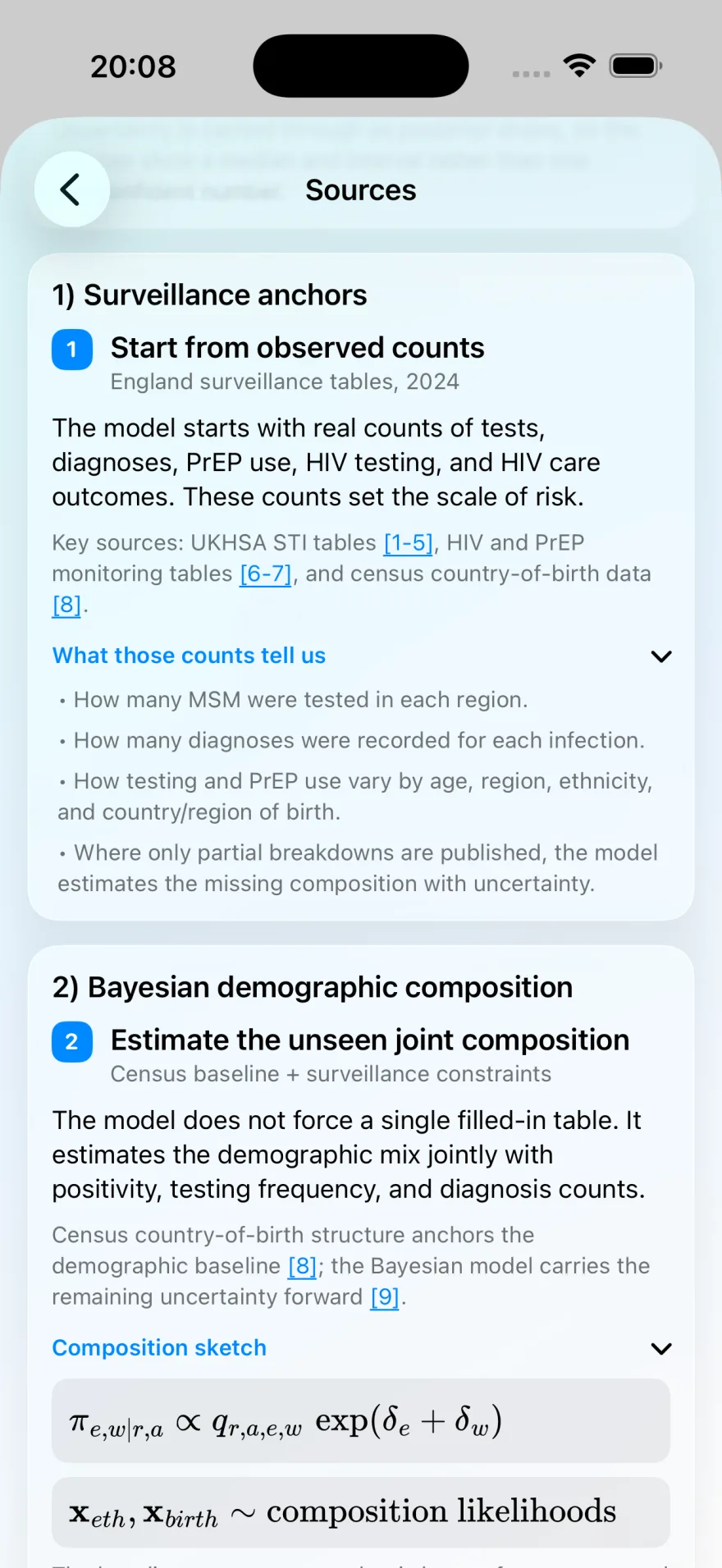
The model combines published per-act transmission probabilities with prevalence data from UK surveillance (UKHSA and ONS), adjusts them for the circumstances of each encounter, and propagates uncertainty through to the final estimate with a Bayesian model. Every assumption and source is documented inside the app.
The app has no account and no backend, and never connects to the internet. There is nowhere for your data to be sent, so the developer and any third party simply never get it.
Your data lives in an on-device database, encrypted at rest while your phone is locked and excluded from iCloud and device backups. Exports are password-protected and unlocked with Face ID.
If you turn it on, the app reads your PrEP doses and can write encounters to Apple Health as "Sexual Activity". Anything in Apple Health is then managed by Apple and may sync via iCloud per your iOS settings. Leave it off and nothing is written there.
SixtyNineMSM provides statistical estimates for educational and informational purposes only. It is not medical advice, not a diagnosis, and cannot detect, confirm, or rule out any infection. Always consult a qualified healthcare professional and get tested.
Each encounter carries a per-act transmission probability drawn from published UK surveillance data. SixtyNineMSM aggregates these across every encounter since your last test, adjusts for the protection recorded, and uses a Bayesian model to fill gaps and quantify the uncertainty in the result.
The baseline prevalence rates come from England (UKHSA and ONS data), so the estimates are calibrated for that population. You can record encounters anywhere, but the further your setting is from that epidemiological context, the less precise the estimates become.
That is the expected case, and the model accounts for it. When serostatus, viral suppression or PrEP use is unknown, SixtyNineMSM applies the prevalence rates for that characteristic across the relevant population, rather than assuming best or worst case.
HIV, gonorrhoea, chlamydia and syphilis. HepB, HPV and Mpox vaccination status is also recorded and factored in where it modifies the per-act transmission probability.
It is optional and off by default. When enabled, the app reads your PrEP dose history and writes encounters to Apple Health as "Sexual Activity" samples. Data in Apple Health is managed by Apple and may sync to your other devices via iCloud, depending on your iOS settings — outside the app's control. Leave it off and nothing is written to Health.
No. It provides statistical estimates for informational purposes and cannot diagnose or exclude any infection. Continue testing on your scheduled interval and consult a healthcare professional with any concerns.
SixtyNineMSM is in open beta on TestFlight ahead of the App Store release.